9 of the Most Successful People share their Reading Habits
By Chris Weller - Business Insider
Read more at
https://www.businessinsider.com/what-successful-people-read-2017-7?IR=T
Most successful people credit reading, in some capacity, as a factor in their success.
A young Elon Musk read for 10 hours each day before growing up to become Tesla CEO.
These days, former Microsoft CEO Bill Gates reads a new book every week.
Here's how some of their peers incorporate reading into their own lives.

"By giving people the power to share, we're making the world more transparent.”
Warren Buffett
Warren Edward Buffett is an American business magnate, investor, and philanthropist, who is the chairman and CEO of Berkshire Hathaway. He is considered one of the most successful investors in the world and has a net worth of US$82 billion as of July 18, 2019, making him the third-wealthiest person in the world
The Berkshire Hathaway magnate reportedly spends five to six hours a day reading five different newspapers.
He also combs through 500 pages of financial documents and recommends prospective investors do the same.
"That's how knowledge works," he recently told an investment class at Columbia University. "It builds up, like compound interest. All of you can do it, but I guarantee not many of you will do it."

"By giving people the power to share, we're making the world more transparent.”
Bill Gates
William Henry Gates III is an American business magnate, investor, author, philanthropist, and humanitarian. He is best known as the principal founder of Microsoft Corporation
Gates says that reading is his favorite hobby and way to indulge his curiosity. His father claims that when Bill was a child, he read so much that they had to institute a rule of no reading at the dinner table.
The former Microsoft CEO has attested to reading 50 books a year, or roughly one book a week.
Most of the books are non-fiction dealing with public health, disease, engineering, business, and science.
Every now and then he'll breeze through a novel (and sometimes in one sitting late into the night). But primarily the books serve Gates' interest in learning more about the world he inhabits.
Gates also shared more than 150 books recommendations through his personal blog, “GatesNotes”.
https://www.businessinsider.sg/bill-gates-favorite-science-books-2017-6/?r=US&IR=T

"By giving people the power to share, we're making the world more transparent.”
Mark Elliot Zuckerberg
Mark Elliot Zuckerberg is an American technology entrepreneur and philanthropist. Zuckerberg is known for co-founding and leading Facebook as its chairman and chief executive officer. He also co-founded and is a board member of the solar sail spacecraft development project Breakthrough Starshot
In 2015, the Facebook CEO vowed to read one book every other week "with an emphasis on learning about different cultures, beliefs, histories and technologies," he wrote in a Facebook post.
"Books allow you to fully explore a topic and immerse yourself in a deeper way than most media today," he wrote. "I'm looking forward to shifting more of my media diet towards reading books."

"The only time you must not fail is the last time you try."
Phil Knight
Philip Hampson "Phil" Knight, whose nickname is "Buck" is an American business magnate and philanthropist. A native of Oregon, he is the co-founder and current chairman emeritus of Nike, Inc., and previously served as chairman and CEO of the company.
According to The New York Times, the Nike founder kept the library behind his executive office so sacred that anyone who entered had to remove their shoes and bow.
When asked by the Times in 2007 if he'd preserved the library after stepping down as CEO three years prior, Knight responded with incredulity.
"Of course the library still exists," he said. "I'm always learning."

“Be thankful for what you have; you'll end up having more. If you concentrate on what you don't have, you will never, ever have enough.”
Oprah Winfrey
Oprah Gail Winfrey is an American media executive, actress, talk show host, television producer and philanthropist.
Since 1996, the veteran talk-show host has been advising her viewers' reading habits with Oprah's Book Club. Winfrey has called reading "her personal path to freedom."
"Books allowed me to see a world beyond the front porch of my grandmother's shotgun house," she said in her acceptance speech for the 2004 United Nations Humanitarian Awards, adding that books gave her "the power to see possibilities beyond what was allowed at the time."

“ Always wake up with a smile knowing that today you are going to have fun accomplishing what others are too afraid to do. “
Mark Cuban
Mark Cuban is an American businessman and investor. He is the owner of the National Basketball Association's Dallas Mavericks, co-owner of 2929 Entertainment, and chairman of AXS TV. He is also one of the main "shark" investors on the ABC reality television series, Shark Tank
Mark Cuban is a vocal supporter of treating business like a sport, which means he looks for the competitive edge however he can.
Often, that means reading for three hours every day, just to learn more about the industries he works in. Cuban has said this worked wonders at the start of his career.
"Everything I read was public," he wrote in his blog's Success and Motivation Series. "Anyone could buy the same books and magazines. The same information was available to anyone who wanted it. Turns out most people didn't want it."
“ I realised how rich I had become and I asked myself, 'Do I really want to be the richest person in the cemetery?”
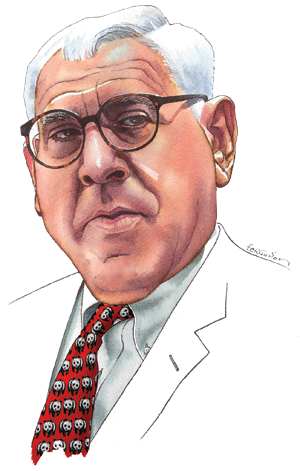
David Rubenstein
David Mark Rubenstein is an American financier and philanthropist best known as co-founder and co-chief executive officer of The Carlyle Group, a global private equity investment firm based in Washington D.C. He is also currently serving as chairman of the Kennedy Center for the Performing Arts and chairman of the board of trustees at Duke University, his alma mater. According to the Forbes ranking of the wealthiest people in America, Rubenstein has a net worth of $3.1 billion.
Rubenstein, reportedly reads up to eight newspapers a day and six books a week.
The philanthropist chalks up his extraordinary ability to a laserlike sense of focus.

"It's OK to have your eggs in one basket as long as you control what happens to that basket."
If you live in Elon Musk's world of endless possibilities and believe in something with all of your heart, anything is possible.
Elon Musk
Elon Reeve Musk is a South African-born American entrepreneur and businessman who founded X.com in 1999 (which later became PayPal), SpaceX in 2002 and Tesla Motors in 2003. Musk became a multimillionaire in his late 20s when he sold his start-up company, Zip2, to a division of Compaq Computers.
Long before he became the CEO of Tesla, and even before he cofounded PayPal, a young Elon Musk was reading science-fiction novels for up to 10 hours a day.
He also reportedly read through the entire Encyclopedia Britannica when he was 9 years old.
He still credits a love of books for his vast knowledge about rockets. When asked how he knew so much about them, he said "I read a lot of books."
Among the most influential books for Musk was Isaac Asimov’s Foundation series. The books focus on the work of a visionary who invents a scientific method for predicting the future based on crowd behavior.

“Live within your income and save so that you can invest. Learn what you need to learn.”
Charlie Munger
Charles Thomas Munger is an American investor, businessman, former real estate attorney, and philanthropist. He is vice chairman of Berkshire Hathaway, the conglomerate controlled by Warren Buffett; Buffett has described Munger as his partner.
Just like the CEO of Berkshire Hathaway Warren Buffet, Charlie loves to read.
Charlie even jokes that he reads so much that his children think that he is a book with a couple of legs sticking out. Here is what he said about reading:
“Warren and I do more reading and thinking and less doing than most people in business. We do that because we like that kind of a life. But we’ve turned that quirk into a positive outcome for ourselves. We both insist on a lot of time being available almost every day to just sit and think. That is very uncommon in American business. We read and think.”